Tejos is a relaxed outdoor game with just enough competition to keep everyone involved. You throw wooden discs toward a small target, trying to finish closer than the other team. The rules are simple, but every round creates choices: place a careful shot, block the next throw, or try to move the game with one bold hit.
Throw your tejos closer to the tejin than the other team.
Bocce, bowls and boules, but with flat wooden discs made for casual outdoor play.
The final throw of a round, when one disc can steal the point or change the whole score.
The idea is simple. The game is not boring.
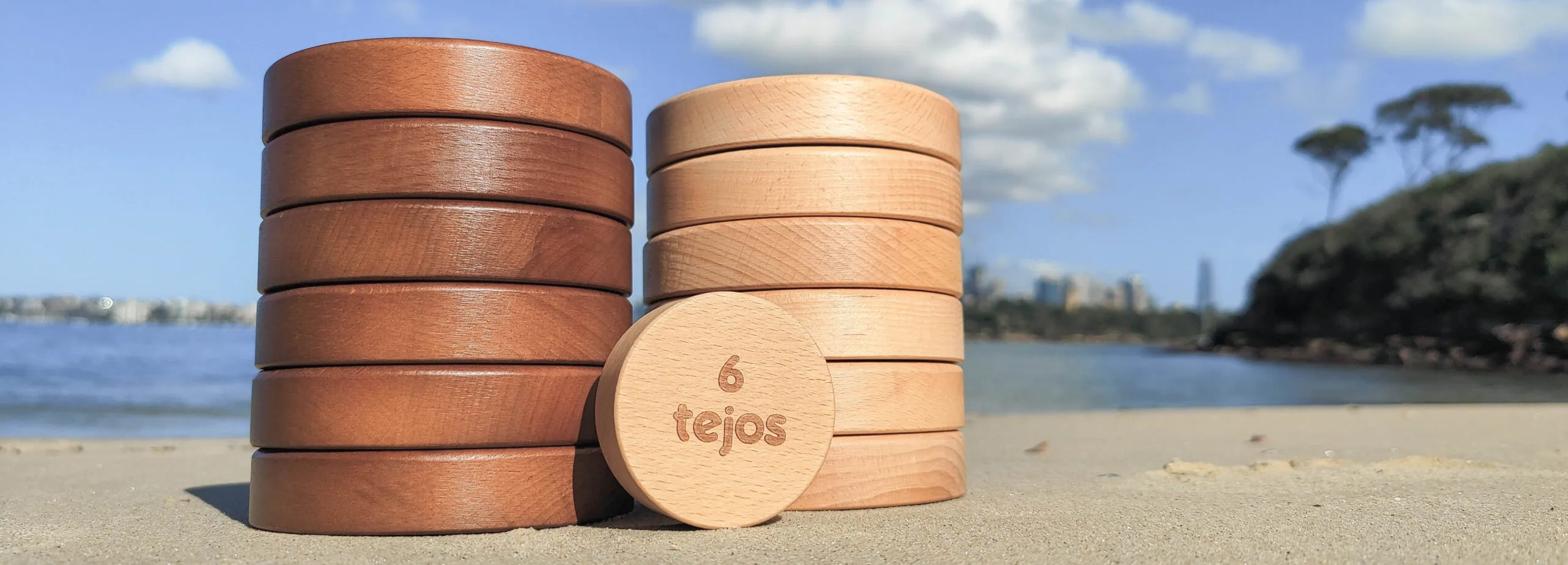
Each team uses a different colour of wooden discs, called tejos. The small target disc is called the tejin. A round starts by throwing the tejin into the playing area, then both teams try to land their tejos closest to it.
If your tejo is already closest, you are protecting the point. If the other team is closer, you have a choice: place a better shot, move the tejin, or hit their tejo out of position. That is where tejos gets its personality. It rewards patience, touch and a little bit of nerve.
A good tejos round feels relaxed until the last few throws. Then it becomes a tiny strategy battle in the sand.
A game from Argentine beach culture
Tejos is strongly associated with the beaches of Argentina, where games are part of the rhythm of a long day outside: family, friends, sun, conversation and a little competition. It belongs to the same wider family as bochas, bocce, petanque, boules and lawn bowls, where the central idea is to place your pieces closer to a target than your opponent.
What makes tejos different is the format. Instead of heavy round balls, tejos uses flat wooden discs. They can slide, stop, skip or turn depending on the surface, so the game feels natural on sand, grass, turf and backyards. It is easy to carry and easy to start, which is exactly why it travels well.
Why people keep playing
It is social from the first throw
You talk, judge distance, debate the shot and celebrate small wins together.
Skill matters, but anyone can join
New players understand the goal immediately. Better players learn weight, angle and surface.
Every surface changes the game
Sand is different from grass. Dry ground is different from damp ground. That keeps it fresh.
The score creates tension naturally
Only the closest team scores each round, so one smart throw can save or steal points.
How tejos compares
| Question | Short answer |
|---|---|
| Is tejos like bocce? | Yes, the target-game logic is similar, but tejos uses flat wooden discs instead of balls. |
| Is it the same as Colombian tejo? | No. Colombian tejo, or turmeque, is a different traditional game with different equipment and rules. |
| Do I need a court? | No. A marked area helps, but you can adapt the game to beach sand, grass, turf or a backyard. |
| How do you win? | Score by being closest to the tejin. In the 6tejos rules, the first team to 15 points wins. |
From beach tradition to Australian weekends
6tejos brings this Argentine-style game to Australia because it fits the way people already spend time outside here. It works after a swim, during a barbecue, at a park picnic, on a camping trip, or in the backyard when people want something competitive without needing a screen, a net, or a perfect field.
That is the real point of tejos: not just the discs, but the excuse to gather around a simple challenge and play one more round.
Learn the rules in a few minutes
The full guide shows the playing area, teams, scoring and round-by-round flow.