6tejos
How to Play
Learn the 6 steps to play tejos!
Throw your tejos as close as possible to the tejin. The first team to score 15 points wins.
The Object
The object of the game is to throw tejos (big discs) as close to the tejin (small disc) as possible. You want to get one or more of your tejos closer to the tejin than your opponent.
The Equipment
Tejin
The tejin is the small disc used as the target in the game. There is only one tejin. The word “tejin” is a Spanish word and it is pronounced “te-hin”.
Tejos
The tejo is the big disc. It comes in two different colours to differentiate the teams: light natural wood colour or dark brown colour.
- Light, natural wood colour
- Dark, brown wood colour
The Classic Set includes 12 tejos, split into two colours for the two teams. The word tejo is a Spanish word and it is pronounced “te-ho”.
Game Play
1. Playing area
The game takes place within a rectangle of 2.5 metres width, about 3 steps, and 6 metres long, about 8 steps. The field is divided in two by a midline, and the throwing line can be either of the short sides of the rectangle.
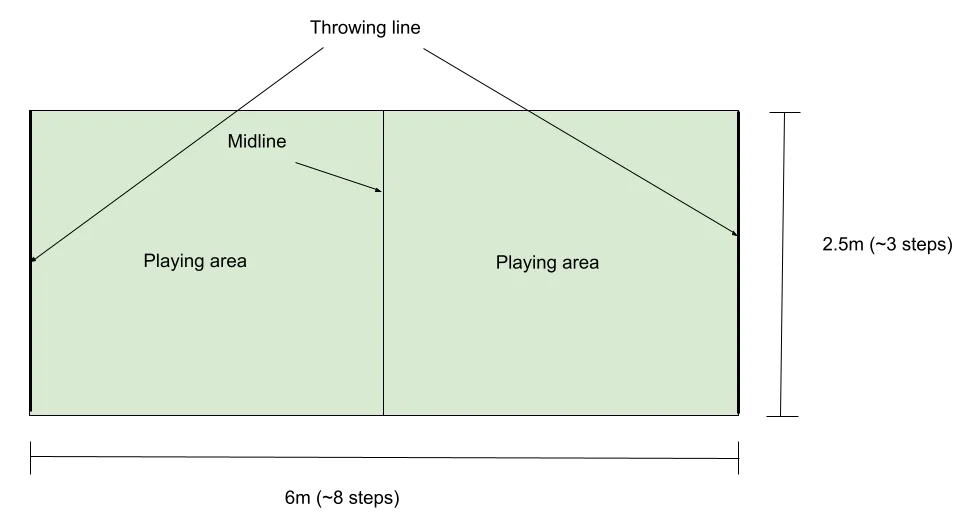
Players must throw the tejos and tejin from behind the throwing line and inside the opposite playing area, beyond the midline.
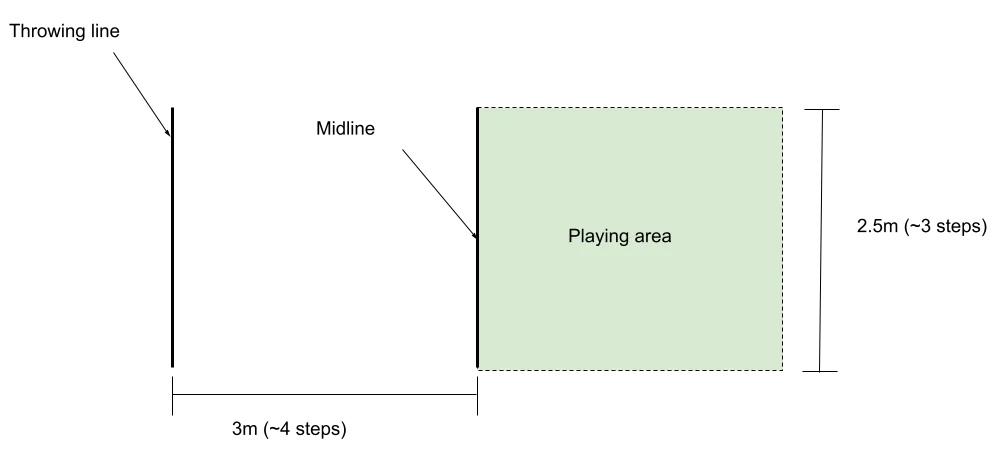
The field can be delimited by drawing the lines with a stick on surfaces like sand. On grass or turf, players can simply play around the tejin, making sure the tejin is initially thrown at least 3 metres from the throwing line.
2. Build the teams
Players are divided equally in 2 teams. Each team chooses the colour of the tejos they want to play with. One team is chosen to start first.
| Team | Tejos per team |
|---|---|
| Singles (1 player on each team) | 6 |
| Doubles (2 players on each team) | 3 |
| Triples (3 players on each team) | 2 |
3. Start the game
The first team starts by throwing the tejin inside the playing area, then throws the first tejo as close as possible to the tejin, which becomes the target.
The tejin must be at least 3 metres from the throwing line. If the player fails to reach the playing area, the other team should throw the tejin as a penalty.
4. Game development
Once the first team plays the tejin and first tejo, the second team goes next.
Taking turns, teams aim to get their tejos as close as possible to the tejin until they get closer than the opponent’s nearest tejo. They can achieve this by:
- Getting their tejo closest to the tejin.
- Moving the tejin closer to their tejos.
- Knocking the opponent’s tejos away.
If a tejo gets outside the playing area, either by being thrown outside or knocked out by another tejo, it is considered a null tejo and will not be counted during the game or for scoring.
Each team decides which team member throws. There is no specific order. For example, players within a team can:
- Alternate one throw each.
- Have one player throw all their tejos, followed by the next player.
- Alternate depending on tejo distribution and player skill.
The only restriction is that every player must throw the same number of tejos. When a team has no more tejos, the other team plays all remaining tejos until no more are left.
The round continues until all tejos have been played.
5. Scoring
Once all players have finished their tejos, the game is scored. The winning team gets one point for each tejo that is closer to the tejin than the opponent’s nearest one. In each round, only the team with the closest tejo to the tejin scores points.
6. Next round
Once the round is over, the team who scores points starts throwing the tejin in the next round. The game continues in rounds until a team scores 15 points.
When playing on delimited surfaces, the game continues from the opposite throwing line.